
Numerique
Source code obsolescence does not justify non-performance of the contract: a key ruling from the Paris Court of Appeal
IT outsourcing (infogérance) is a contract whereby a company entrusts the management of its information system to a specialised service provider.
Reading time:
3 min
Source code obsolescence does not justify non-performance of the contract: a key ruling from the Paris Court of Appeal.
IT outsourcing (infogérance) is a contract whereby a company entrusts the management of its information system to a specialised service provider.
This practice, which is common in the digital age, was at the heart of a recent dispute, examined in detail in a ruling of the Paris Court of Appeal dated 26 May 2023 (RG no. 21/05700).
Facts
In this case, Qapa, a company specialising in connecting candidates with job offers through its website, had signed an IT outsourcing contract with Solocal, the owner of the job listing websites 'embauche.com' and 'kapstages.com'. Under the terms of the contract, Qapa was responsible for the hosting, maintenance and redesign of the websites.
After more than a year, Qapa argued that the kapstages.fr website was obsolete at the time of its acquisition. The source code, as well as the technologies used - MySQL dating from February 2009, Apache from 2006 and the website's programming language from 2013 - were largely outdated, rendering the website unusable. Qapa claimed that this obsolescence, concealed by Solocal, justified the non-performance of its contractual obligations.
However, the Paris Court of Appeal took a different view.
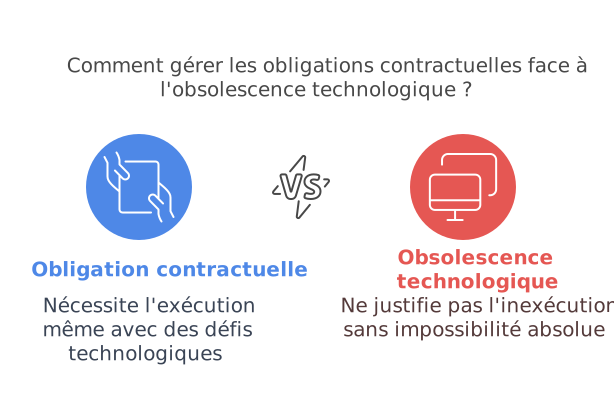
It held that source code obsolescence could not, on its own, justify Qapa's non-performance of its contractual obligations.
This ruling is all the more significant in that it addresses an aspect often overlooked in IT outsourcing contracts: source code obsolescence. Indeed, while technology evolves at a frantic pace, the question of the obsolescence of IT systems is increasingly relevant in the field of digital law. However, as this case demonstrates, merely establishing that code is obsolete is not sufficient to release a service provider from its contractual obligations.
Recommendations
Companies entering into IT outsourcing contracts must therefore exercise vigilance. It is essential to conduct a thorough audit of the IT systems concerned before signing an IT outsourcing contract, in order to avoid finding themselves in a situation comparable to that of Qapa.
It would also be prudent to include specific contractual provisions concerning source code obsolescence, particularly within the framework of software law.
For example, the parties could agree on a plan for regular updates of the code or on a clause allowing termination of the contract in the event of established obsolescence.
Finally, it should be recalled that non-performance of a contract can only be justified by an absolute impossibility of performance. Mere difficulty or the additional cost generated by an unforeseen situation - such as source code obsolescence - is generally not sufficient.
The ruling of the Paris Court of Appeal thus highlights the importance of proactive management of IT outsourcing contracts. In a constantly evolving technological world, companies must anticipate potential problems and take steps to mitigate them.
In conclusion, this case offers a valuable lesson for companies involved in IT outsourcing contracts. While source code obsolescence may be a major challenge, it cannot serve as a pretext for evading contractual obligations. This ruling of the Paris Court of Appeal therefore constitutes an important milestone in the case law relating to IT outsourcing contracts.
This may seem complex, but you do not have to handle it alone. As a lawyer experienced in this field, I am here to help you review and optimise your IT outsourcing contracts. I can help you identify potential risks, clarify your obligations and protect your interests.
Do not wait until problems arise. Contact me today and let us take control of your digital future together. Let us protect your company against the unexpected and position ourselves for success in a constantly evolving technological world. You can count on my expertise and dedication to support you at every step.
To learn more
What did the Paris Court of Appeal rule regarding source code obsolescence?
In its ruling of 26 May 2023 (RG no. 21/05700), the Paris Court of Appeal held that source code obsolescence could not, on its own, justify the non-performance of contractual obligations. This is a key ruling in matters relating to IT outsourcing contracts.
What is an IT outsourcing contract?
It is the contract whereby a company entrusts the management of its information system to a specialised service provider. It may cover the hosting, maintenance and redesign of websites or applications. A common practice in the digital sector, it raises questions of liability in the event of technical difficulties.
Can the obsolescence of a system justify not performing a contract?
According to the ruling of the Paris Court of Appeal, no, not on its own. A service provider who invokes source code obsolescence to avoid fulfilling its obligations risks having this argument dismissed. Obsolescence is not sufficient to be released from the contract.
How can obsolescence be anticipated in an IT outsourcing contract?
The contract must expressly address the issue: the state of the systems at the time of takeover, update obligations, and the allocation of responsibilities in the event of outdated technologies. Providing for these aspects in advance prevents obsolescence from becoming an unforeseen point of dispute.
What should a service provider check before taking over IT outsourcing?
It is advisable to audit the actual state of the systems being taken over, including the age of the technologies and the code. Documenting this initial state and incorporating it into the contract helps to clarify responsibilities and avoid pre-existing obsolescence being held against the provider at a later stage.
Does this ruling concern all IT contracts?
It concerns IT outsourcing, but its reasoning sheds light more broadly on digital contracts: technical obsolescence does not, in itself, exempt a party from performing its obligations. It calls for the question of the evolution and ageing of systems to be addressed contractually.
Why is obsolescence a growing concern?
Because technology evolves very quickly and systems can rapidly become outdated. The question of the obsolescence of code and infrastructure is therefore increasingly present in digital law disputes, which justifies anticipating it in contracts.
How can an IT outsourcing contract be secured?
By precisely defining the scope, the initial state of the systems, the maintenance and update obligations, the service levels and the allocation of responsibilities. Legal support makes it possible to anticipate sensitive points such as obsolescence and to reduce the risk of litigation.
Still have questions?
Our team is available!
Have a question?

Ressources
Aller plus loin





Digital and Distribution Law Attorney, Paris Bar. We secure your contracts, data, and business.
Services
Sectors