

In an ever-changing digital world, software publishers face an increasingly complex legal environment. Between new European regulations and increasing cybersecurity threats, it is essential to identify legal risks in order to better anticipate them.
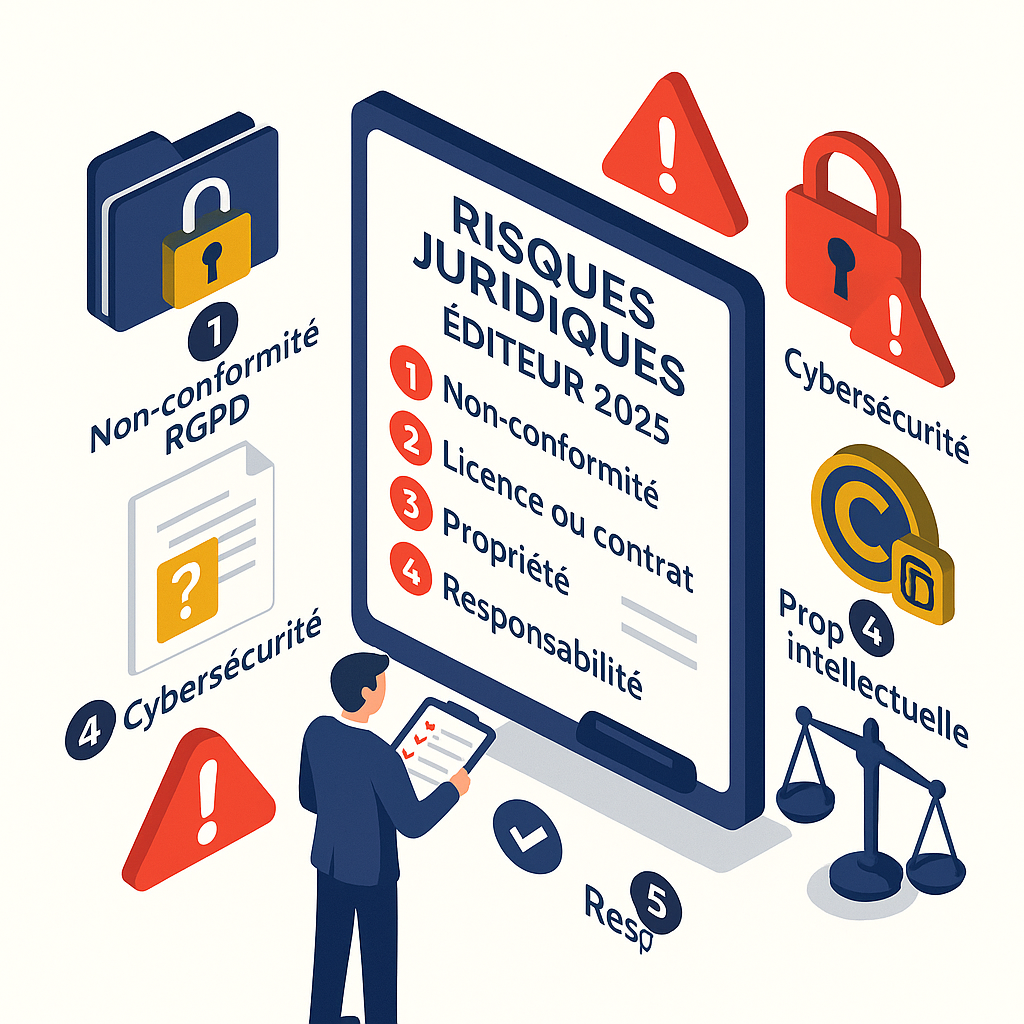
This article presents the five main risks to which software publishers need to be particularly attentive in 2025.
If you're looking for a software and database lawyer, contact me!
1. Counterfeiting and piracy: a persistent threat
Despite technological advances in protection, counterfeiting and piracy remain major risks for software publishers. In 2025, these illicit practices have become more sophisticated, with the emergence of new techniques enabling traditional protection mechanisms to be circumvented.
The consequences for publishers are manifold:
- Direct financial losses due to loss of revenue
- Devaluation of intellectual property
- Damage to reputation among legitimate customers
- Safety risks for end users
La protection du code source constitue donc une priorité absolue. Les avocat droit des logiciels et bases de données recommandent de mettre en place une stratégie de protection à plusieurs niveaux, combinant des mesures techniques (obfuscation, chiffrement) et juridiques (dépôts auprès d’organismes spécialisés, contrats de confidentialité).
2. The RGPD's enhanced obligations for publishers
The General Data Protection Regulation continues to evolve, with case law interpretations reinforcing the obligations of software publishers. In 2025, particular attention will be paid to software that processes personal data, even in a secondary way.
For publishers, this means :
- An increased obligation to document the compliance of their solutions
- The need to integrate data protection right from the design stage (Privacy by Design)
- The obligation to carry out impact assessments for sensitive processing operations
- The implementation of mechanisms enabling users to exercise their rights easily
Les sanctions en cas de non-conformité atteignent désormais des montants dissuasifs, pouvant aller jusqu’à 6% du chiffre d’affaires mondial pour les infractions les plus graves, une augmentation notable par rapport au plafond initial de 4%. L’accompagnement d’un avocat spécialisé en protection des données et RGPD est essentiel pour assurer cette conformité.
3. The European Regulation on Digital Operational Resilience (DORA)
Coming fully into force in January 2025, the DORA (Digital Operational Resilience Act) regulation imposes new requirements on software vendors supplying solutions to the financial sector. This text, which aims to strengthen the resilience of the financial system in the face of IT incidents, has direct implications for software publishers.
The main obligations concern :
- Regular stress tests
- The ability to demonstrate the robustness of infrastructures
- Rigorous management of third-party service providers
- Rapid notification of major incidents
Publishers who fail to meet these obligations expose themselves not only to administrative sanctions, but also to liability claims from their customers in the financial sector.
4. Liability for security breaches
The growing number of cyber-attacks and their increased media coverage have led to a hardening of the courts' position on the liability of software publishers in the event of security breaches. Judges now consider that professional software publishers have an obligation of result in terms of security, particularly for critical functions.
This development in case law is reflected in :
- A presumption of liability for "obvious" vulnerabilities
- The obligation to carry out regular safety audits
- The duty to inform and quickly correct discovered vulnerabilities
- The need to maintain an active watch on new threats
To guard against these risks, it is advisable to consult a software and database lawyer who can help you set up appropriate procedures and draft contractual clauses limiting your liability to the limits authorized by law.
5. Intellectual property issues in the context of artificial intelligence
The growing use ofartificial intelligence in software development raises important intellectual property issues. The generative AI models used to produce code pose unprecedented challenges in terms of rights attribution.
Points to watch include :
- Determining ownership of rights to AI-generated code
- Risks of unintentional infringement of third-party rights by AI
- The patentability of AI solutions
- Protecting know-how in learning algorithms
Les tribunaux commencent tout juste à se prononcer sur ces questions, créant un environnement juridique incertain pour les éditeurs qui intègrent ces technologies. L’expertise d’un avocat spécialisé en droit de l’intelligence artificielle devient indispensable pour naviguer dans ce nouveau territoire juridique.
Securing your publishing business: the importance of specialized legal expertise
Faced with these major legal risks, a proactive approach is essential for software publishers in 2025. Compliance must no longer be perceived as a constraint, but as a competitive advantage, helping to reassure customers and investors.
La complexité du cadre juridique applicable aux logiciels nécessite une expertise spécifique. Faire appel à un avocat spécialisé permet non seulement d’éviter les écueils réglementaires mais aussi de transformer les contraintes juridiques en opportunités de différenciation.
To ensure the legal security of your publishing business and implement an effective protection strategy for your digital assets, don't hesitate to consult a specialized law firm that can guide you through this ever-changing regulatory maze.