

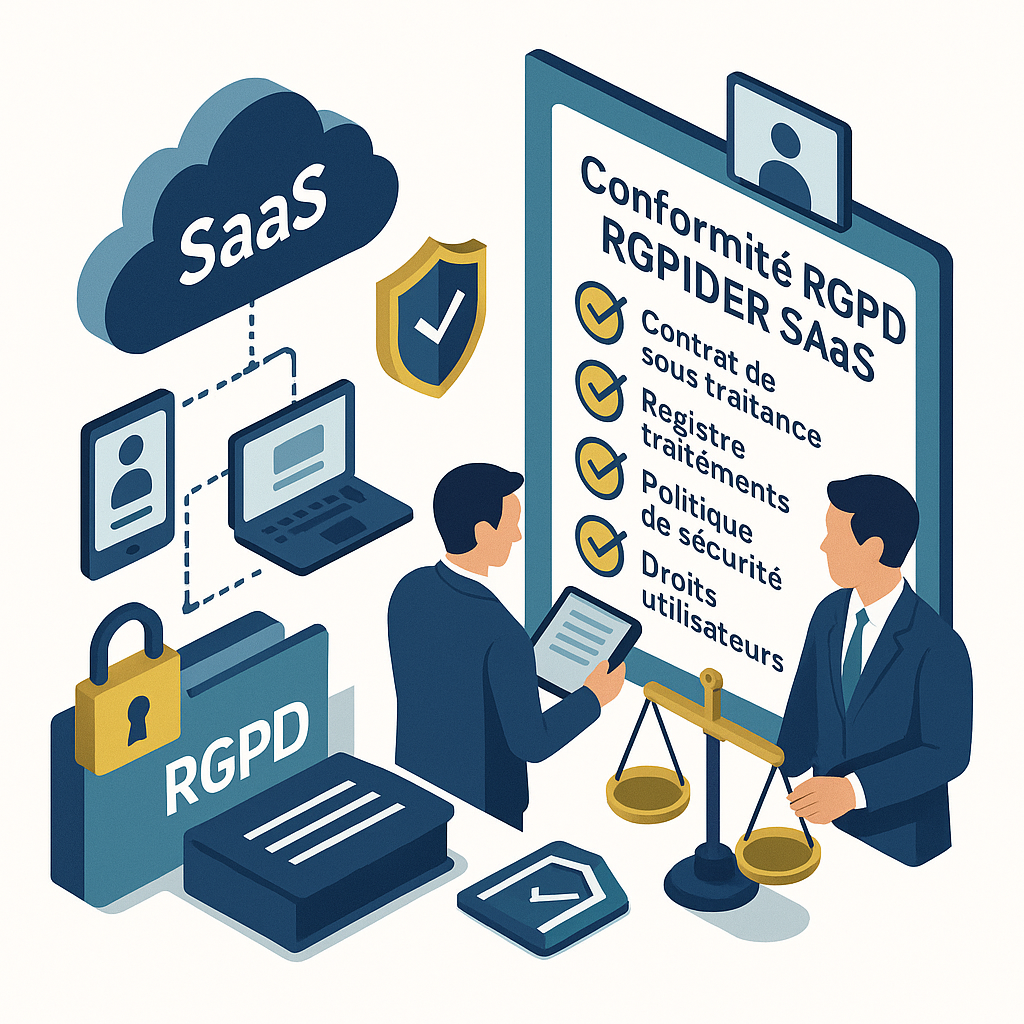
In the age of digital transformation, SaaS (Software as a Service) solutions have become the standard for business software distribution. This evolution is accompanied by an increased responsibility on the part of publishers in terms of data protection. The General Data Protection Regulation (GDPR) has profoundly transformed the legal landscape, imposing strict obligations and dissuasive penalties in the event of non-compliance.
If you would like to use a SaaS lawyer, please contact me!
Understanding the specific legal position of SaaS publishers
The particularity of the SaaS model lies in the fact that customer data is hosted and processed by the publisher, creating a specific legal configuration:
- Legal qualification: As a SaaS publisher, you are generally considered a processor within the meaning of the RGPD, with your customers being the data controllers.
- Shared responsibility: This relationship creates a regime of shared responsibility in which each party must meet specific obligations.
- Chaîne de sous-traitance : Si vous faites appel à d’autres prestataires (hébergeurs, services tiers), vous devenez responsable de leur conformité. Un avocat spécialisé en contrat d’hébergement informatique peut vous assister dans la négociation et la rédaction de ces contrats d’hébergement conformes au RGPD.
- Co-processing: In certain cases, you may be qualified as a co-processor, in particular when you yourself determine certain purposes.
This qualification has major implications for your legal and contractual obligations. To secure your position, consulting a saas lawyer will enable you to precisely identify your status and the requirements associated with your specific situation.
Integrate the "Privacy by Design" principle into your SaaS solution
One of the fundamental requirements of the RGPD is the integration of data protection right from the design of your SaaS solution:
- Data minimization: Limit data collection to that which is strictly necessary for your functionalities.
- Default settings: Configure initial settings for maximum protection (opt-in rather than opt-out).
- Access controls: implement fine-tuned management of access rights based on the principle of least privilege.
- Encryption: Use robust encryption algorithms for data in transit and at rest.
- Partitioning: Ensure effective separation between data from different customers.
Un audit technique réalisé par des experts en sécurité et en conformité vous permettra d’identifier les axes d’amélioration de votre solution et d’intégrer ces principes dès les premières phases de développement. Un avocat pour les contrats de développement logiciel peut vous accompagner dans l’intégration de clauses de conformité RGPD dès la phase de conception.
Drafting contractual clauses adapted to the RGPD
The relationship between the SaaS publisher and its customers must be framed by specific contractual provisions meeting the requirements of Article 28 of the RGPD :
- Purpose and duration of processing: Describe precisely what data is processed, for what purposes and for how long.
- Documented instructions: Specify that you act only on documented instructions from the customer.
- Confidentiality: Make sure that all persons authorized to process data are subject to an obligation of confidentiality.
- Security: Detail the technical and organizational measures implemented to guarantee data security.
- Subcontracting: Strictly control the use of other subcontractors and obtain prior authorization.
- Assistance: Define how you support your customers in complying with their own obligations (personal rights, impact analysis, breach notification).
- Fate of data: Clarify how data will be returned or deleted at the end of the contract.
- Audits: Plan the conditions under which your customers can audit your compliance.
Ces clauses doivent être adaptées à votre modèle spécifique et aux particularités de votre solution. Des modèles génériques présentent des risques importants de non-conformité. Un avocat spécialisé en droit des logiciels et des bases de données peut vous aider à rédiger ces clauses en tenant compte des spécificités techniques de votre solution.
Implement effective user rights management
Your SaaS solution must make it easy for customers to comply with the rights conferred on data subjects by the RGPD :
- Right of access: Include retrieval functionalities enabling your customers to provide data subjects with a copy of their data.
- Right of rectification: Make it easy to correct inaccurate data directly in the interface or via documented procedures.
- Right to deletion: Implement permanent deletion mechanisms to respond to requests for deletion.
- Right to limitation: Offer the possibility of temporarily suspending the processing of certain data without deleting them.
- Right to portability: Allow data to be exported in a structured, commonly used and machine-readable format.
- Oppose treatments: Suggest simple ways to disable specific treatments.
These features often represent a significant competitive advantage, particularly for customers subject to stringent regulatory constraints.
Document your RGPD compliance and prepare for audits
The RGPD compliance approach requires structured documentation that will be essential in the event of an inspection by a data protection authority:
- Register of processing activities: Comprehensively document the processing activities you carry out as a subcontractor.
- Security policy: formalize your approach to data security in a reference document.
- Internal procedures: Establish clear procedures for managing incidents, exercising rights and upgrading your solution.
- Team training: Make sure your employees are trained and aware of data protection issues.
- Security testing: Perform regular penetration tests and security audits to identify and correct vulnerabilities.
- Certifications: Consider certifications such as ISO 27001 or specific data protection labels to add value to your approach.
The quality of this documentation will be decisive in demonstrating your compliance, and that of your customers, in the event of an inspection.
Anticipate and manage data breaches in compliance with the RGPD.
As a SaaS vendor, you need a robust system for detecting, managing and notifying data breaches:
- Early detection: Implement systems for monitoring and detecting security incidents.
- Incident qualification: Establish a clear methodology for qualifying a data breach and assessing the associated risks.
- Notification procedure: Formalize a procedure for notifying your customers within 48 hours of discovering a violation.
- Documentation: Keep a record of violations, including facts, effects and action taken.
- Assistance: Support your customers in their own obligations to notify the authorities and persons concerned.
- Feedback: Systematically analyze incidents to reinforce your preventive measures.
Responsiveness and transparency in the event of a breach are crucial elements in building trust with your customers.
Anticipating international data transfers
If your technical architecture involves data transfers outside the European Union, specific guarantees must be implemented:
- Flow mapping: precisely identify all data transfers outside the EU, including those carried out by your subcontractors.
- Transfer mechanisms: Put in place appropriate safeguards (adequacy decision, standard contractual clauses, binding corporate rules).
- Risk assessment: Following the Schrems II ruling, carry out an analysis of the specific risks associated with each transfer.
- Additional measures: Identify and implement additional technical or organizational measures if necessary.
- Transparency: Clearly inform your customers about transfers and guarantees.
Constant developments in case law in this field require rigorous legal monitoring and regular adjustments to your contractual documentation.
Conclusion
RGPD compliance represents an ongoing process that must adapt to changes in your SaaS solution, regulatory amendments and new case law. Beyond the purely regulatory aspect, a rigorous approach to data protection is a significant commercial asset in a market where digital trust is becoming a decisive selection criterion.
SaaS publishers who fully integrate these issues into their product strategy and governance transform this regulatory constraint into a differentiating opportunity. Investing in compliance is a key factor in long-term success, particularly for access to the most demanding markets in terms of data protection.
A proactive, structured approach, supported by legal and technical experts, will enable you to consolidate your customers' trust and secure your long-term development in an increasingly complex regulatory environment.